
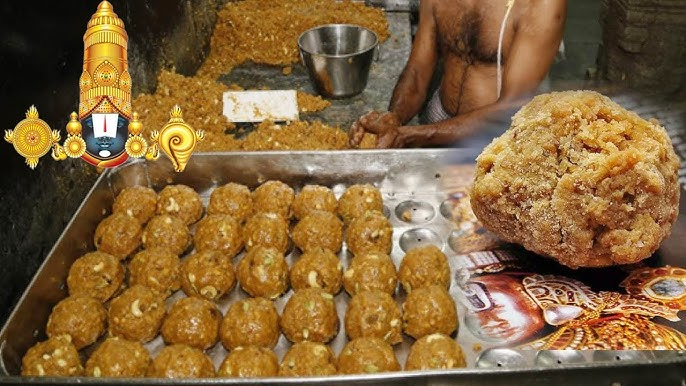
The controversy involving AR Dairy Food Private Limited, a Tamil Nadu-based ghee supplier, began when the Tirumala Tirupati Devasthanams (TTD), the governing body of the Sri Venkateswara Temple in Tirupati, initiated legal action against the company. AR Dairy was accused of supplying adulterated ghee to the temple, which is used in preparing the famous Tirupati laddus, a popular religious offering (or ‘prasadam’). The TTD also blacklisted the company following these allegations.
The allegations came after a report by the National Dairy Development Board (NDDB) revealed that samples of ghee supplied by AR Dairy contained traces of animal fat. Specifically, the issue gained attention when claims were made that fish oil or animal fat had been used to adulterate the ghee. The use of non-vegetarian ingredients in temple prasadam has understandably caused an uproar, as it would violate the religious and cultural sanctity associated with the temple’s offerings.
AR Dairy quickly denied these claims. Kannan, a quality control officer at AR Dairy, called the allegations unsubstantiated and stated that fish oil is more expensive than ghee, adding that its use would be immediately detectable by smell alone. He pointed out that adulteration of this nature would not make economic sense, nor could it go unnoticed.
Kannan also emphasized that this was the first time such accusations had been raised against AR Dairy since its operations began in 1988. He assured the public that their ghee is thoroughly tested in national laboratories before being sent to TTD and that TTD’s own food safety officer also conducts checks upon arrival. He maintained that AR Dairy produces only a small volume of the total ghee used for the temple’s prasadam.
AR Dairy further asserted that they hold ISO certification and follow strict quality control measures. The company runs its own procurement centers and employs advanced technology capable of testing 102 quality parameters of milk in just 32 seconds. According to Kannan, any batch that fails these stringent tests is immediately rejected. He also highlighted that a four-member expert team from TTD had previously visited their plant to assess their production capacity and quality control systems.
TTD’s Officer J Shyamala Rao responded by explaining that the legal action was initiated after samples of ghee provided by AR Dairy were found to be highly adulterated in four out of ten tankers. The decision to blacklist the company came after complaints were raised about the declining quality of the laddus.
The issue escalated politically as well when N. Chandrababu Naidu, the former Chief Minister of Andhra Pradesh, claimed that the previous administration, led by YS Jagan Mohan Reddy, had allowed the use of animal fats and fish oil in the preparation of the prasadam. These claims added further controversy to the situation.
Dr. Sathish Kumar, an official from the Food Safety Department in Chennai, mentioned that the state adheres strictly to FSSAI guidelines for detecting food adulteration. When suspicions arise, multiple samples are collected in the presence of witnesses, and laboratory tests are conducted. If contamination is detected, the supplier is given 30 days to appeal the findings.
Both Kannan from AR Dairy and Dr. Sathish Kumar pointed out that the smell of fish oil and the presence of animal fat would be immediately noticeable to those unaccustomed to these substances, making it highly unlikely that such adulteration could go undetected.
AR Dairy has expressed concern that these allegations are severely damaging their business and reputation. Despite their long-standing relationship with TTD, these accusations have led to a significant backlash. Kannan stressed that for the company, supplying ghee to TTD is not just a business but a blessing and a matter of honor.
As of now, AR Dairy is denying the allegations and urging for a transparent investigation into the sample collection and testing process. They are calling for the use of measures such as video recording during sample collection to ensure accountability. Meanwhile, the legal proceedings and further testing of ghee samples will determine the future of the company’s relationship with TTD and its credibility in the marketplace.