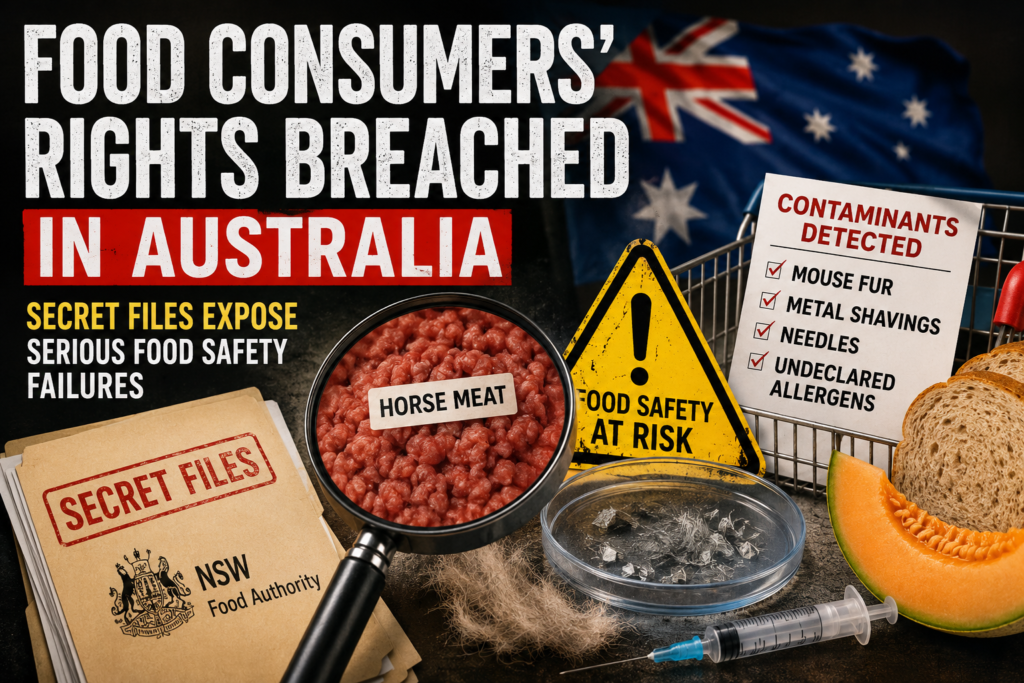
Secret government documents obtained through parliamentary powers have raised alarming concerns about food safety and consumer rights in Australia, revealing incidents where horse meat, mouse fur, metal shavings, needles, and undeclared allergens were detected in food products.
The revelations emerged as part of an investigation by ABC Four Corners, after New South Wales Greens MP Abigail Boyd secured access to thousands of internal documents from the NSW Food Authority using parliamentary Standing Order 52 powers.
According to Boyd, the documents expose significant weaknesses in Australia’s food safety system and suggest that consumers’ trust in the country’s food supply may be misplaced.
“You could be eating minced horse when you think you’re eating beef mince,” Boyd said, describing the findings as shocking for ordinary Australians.
The confidential files reportedly document multiple cases where food products contained substances that should never have been present, including:
Boyd stated that several issues were identified accidentally by consumers rather than through company quality control systems.
Documents released publicly under the parliamentary order show that between 2022 and 2026, hundreds of businesses—including hospitals, aged-care homes and catering companies—received enforcement notices for food safety violations.
Common breaches included:
More than 100 businesses reportedly received repeated improvement notices for recurring violations.
The NSW Food Authority regulates approximately 14,500 licensed food businesses, including meat processors, dairy facilities, seafood operators, egg producers, hospitals and aged-care food services.
Despite repeated breaches across numerous facilities, reports indicate that no food business licence has been cancelled by the authority over the past seven years, raising concerns about the effectiveness of enforcement measures.
The authority said it follows a risk-based regulatory approach and takes stronger enforcement action where an immediate public health risk exists.
The released records also show repeated food safety issues within several aged-care providers and catering companies supplying vulnerable populations.
Inspectors identified problems such as:
The organisations involved stated that corrective actions were implemented following inspections and that improvements had been made.
One fruit and vegetable operator reportedly failed to notify the NSW Food Authority within the legally required 24-hour period after detecting Listeria contamination in rockmelon.
Listeriosis is a serious foodborne illness that poses significant risks to pregnant women, newborns, older adults and people with weakened immune systems.
Australia experienced a major rockmelon-linked listeriosis outbreak in 2018 that contributed to seven deaths and one miscarriage.
According to Boyd, confidential documents also describe cases involving illegal slaughter operations and serious animal welfare concerns.
She alleged that horses and other animals from illegal knackeries may have entered the food supply chain and been sold as beef or lamb products.
These allegations have renewed calls from experts for Australia to establish a dedicated Food Fraud Unit, similar to those operating in Europe, Canada and the United States, to improve food authenticity testing and strengthen consumer protection.
The NSW Food Authority said certain documents remain confidential to protect commercially sensitive information, avoid reputational damage from unsubstantiated allegations, and preserve the integrity of ongoing investigations.
The authority also stated that it uses its regulatory powers to immediately stop activities that pose a direct risk to public health.
The findings have sparked renewed debate about transparency, enforcement and the protection of consumer rights within Australia’s food safety system.