
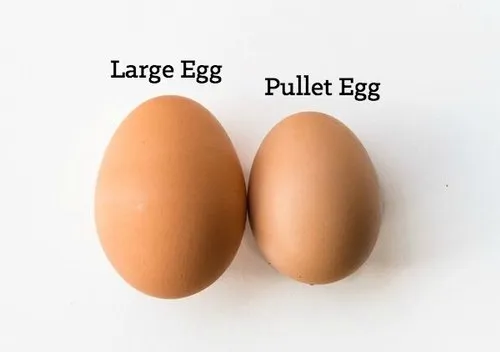
Tiny eggs being sold at unusually low prices have recently triggered questions and speculation on social media, with some posts referring to them as “bullet eggs.” Claims circulating online have suggested that these unusually small eggs could be artificial, unhealthy, linked to diseased chickens or even unsafe to eat.
But poultry experts say the story is much less mysterious.
The eggs commonly described online as “bullet eggs” are actually pullet eggs a well-known type of small egg produced naturally by young hens when they first begin laying. The term “bullet egg” has no recognized scientific or standard commercial meaning in poultry production. The confusion appears to have stemmed largely from the mispronunciation or misunderstanding of the word “pullet.”
A pullet is a young female chicken that has reached the stage at which she begins producing eggs. When a hen first enters egg production, her reproductive system is still maturing. As a result, her initial eggs can be considerably smaller than the eggs she will produce later.
These early eggs are known as pullet eggs.
Egg size is not fixed throughout a hen’s laying life. As young hens mature, the size of the eggs they produce generally increases. Small first eggs are therefore a normal part of the egg-production cycle rather than evidence of a new or abnormal variety of egg.
In other words, the small size is primarily a reflection of the age and maturity of the hen, not an indication that the egg has been manufactured or altered.
Egg formation is a biological process, and young hens do not immediately produce eggs of the same size as fully mature laying hens.
During the early stage of production, the hen’s reproductive system is still developing. The amount of yolk and albumen deposited during egg formation can therefore result in smaller eggs.
With continued maturation, hens generally begin producing larger eggs that move toward the sizes normally sold in the market.
This explains why a carton containing unusually tiny eggs does not automatically indicate a food-safety problem.
Price is another reason these eggs have attracted attention.
Eggs are commonly sold according to size and market specifications. Smaller eggs contain less total edible material than larger eggs, so they can command a lower price.
Therefore, a cheaper pullet egg does not automatically mean that it is inferior, fake, nutritionally empty or unsafe.
The situation is similar to other agricultural products that are sold at different prices depending on size and grade. Smaller size can affect market value without making the food inherently unsafe.
There is no basis for assuming that a small egg is automatically nutritionally deficient simply because it is smaller.
The major difference is quantity. A smaller egg contains less total egg material than a larger egg, so naturally it will provide fewer calories and nutrients per egg.
That is different from saying that the egg itself is nutritionally “bad.”
Consumers should therefore distinguish between egg size and egg quality.
A tiny egg from a healthy laying hen is not equivalent to an egg that has been visibly damaged, spoiled or contaminated.
The term appears to have gained attention through social media and online discussions.
According to poultry experts cited in reports debunking the claim, “bullet egg” is not a recognized scientific poultry term. The more likely explanation is that “pullet” was heard or repeated as “bullet.”
Once the unusual name began circulating, speculation followed.
Some online discussions connected the small eggs with diseases in poultry, while others raised concerns about Salmonella. These are separate issues.
A small pullet egg should not be confused with an abnormally formed egg, and neither should be automatically equated with Salmonella contamination.
Diseases affecting laying hens can sometimes cause changes in egg quality.
For example, infections such as Infectious Bronchitis can affect egg production and shell quality. Eggs may show abnormalities such as thin, rough or wrinkled shells. Newcastle Disease can also affect poultry health and production.
However, these abnormal eggs are fundamentally different from normal small pullet eggs.
A pullet egg is small because it is produced by a young hen beginning her laying cycle. An egg with an abnormal shell or other physical defect may have a completely different underlying cause.
Experts therefore caution against using the size of an egg alone as evidence that the bird was sick.
This is where consumers need to separate myth from legitimate food-safety concerns.
Pullet eggs are not inherently “Salmonella eggs.”
However, Salmonella is a genuine food-safety concern associated with eggs in general. The bacteria can contaminate eggs, and contamination may not necessarily be visible from the outside.
Recent food-safety events have demonstrated why consumers should continue to handle eggs carefully. In July 2026, nearly 1.6 million dozen eggs in the United States were recalled over potential Salmonella Enteritidis contamination. No illnesses had been reported at the time of the recall announcement, but the affected eggs were removed from distribution and consumers were advised not to eat them.
That recall has nothing to do with pullet eggs specifically. It illustrates a broader point: egg safety depends on production, handling, storage and contamination controls—not simply on the size of an egg.
No. Salmonella contamination cannot reliably be identified simply by looking at an egg, smelling it or judging its size.
This is why food-safety authorities emphasize proper handling and cooking rather than relying on appearance.
The U.S. FDA advises consumers to keep eggs refrigerated, cook eggs thoroughly and avoid consuming raw or undercooked eggs when using ordinary shell eggs.
Regardless of whether an egg is large, medium or unusually small, basic food-safety practices remain important.
Purchase eggs from reputable retailers, established suppliers or trusted producers. Avoid eggs whose origin or handling conditions are unclear.
Cracked or damaged shells can increase the opportunity for contamination. Food-safety guidance recommends discarding cracked eggs rather than taking unnecessary risks.
Where refrigeration is recommended for the eggs being purchased, keep them refrigerated and avoid prolonged periods at room temperature. U.S. food-safety guidance recommends keeping refrigerated eggs at 40°F (4.4°C) or below.
Storage practices can vary between countries because egg-washing and production systems differ, so consumers should follow the storage instructions applicable to their market.
For the safest consumption, food-safety authorities recommend cooking eggs until the whites and yolks are firm. Egg-containing dishes should also reach an appropriate safe internal temperature. The USDA recommends 160°F (71°C) for dishes containing eggs.
Raw and undercooked egg dishes carry greater food-safety risks, particularly for vulnerable groups.
Wash hands, utensils and food-contact surfaces after handling raw eggs. This helps prevent bacteria from spreading from raw egg to ready-to-eat foods.
Several conclusions circulating online are not supported simply by finding a small egg.
Small egg ≠ fake egg
There is no reason to assume an egg is artificial merely because it is unusually small.
Small egg ≠ diseased egg
Pullet eggs are naturally produced by young hens. Disease-related abnormalities are a separate issue.
Small egg ≠ Salmonella contamination
Egg size does not tell consumers whether an egg contains Salmonella.
Cheap egg ≠ unsafe egg
Lower price can simply reflect the smaller size and market value of the product.
The viral “bullet egg” discussion demonstrates how quickly an unfamiliar agricultural term can turn into a food-safety rumour.
The word “pullet” describes the young hen, while “pullet egg” describes the small eggs she produces early in her laying period. It is not the name of a mysterious new egg variety.
At the same time, consumers should not take the debunking of the “bullet egg” myth to mean that all egg-safety concerns are unfounded. Salmonella remains a legitimate foodborne hazard, and recent egg recalls demonstrate the importance of surveillance, traceability and responsible food handling.
The sensible approach is therefore neither panic nor complacency.
A small egg is not automatically a dangerous egg. But every egg should still be handled and cooked safely.
The tiny eggs appearing in markets or social-media posts are most likely pullet eggs — naturally small eggs laid by young hens beginning their laying cycle. Their smaller size can explain their lower price and does not, by itself, indicate poor quality, disease or Salmonella contamination.
For consumers, the important checks are not whether an egg is “bullet-sized,” but whether it comes from a reliable source, has an intact shell, has been stored appropriately and is cooked safely.