
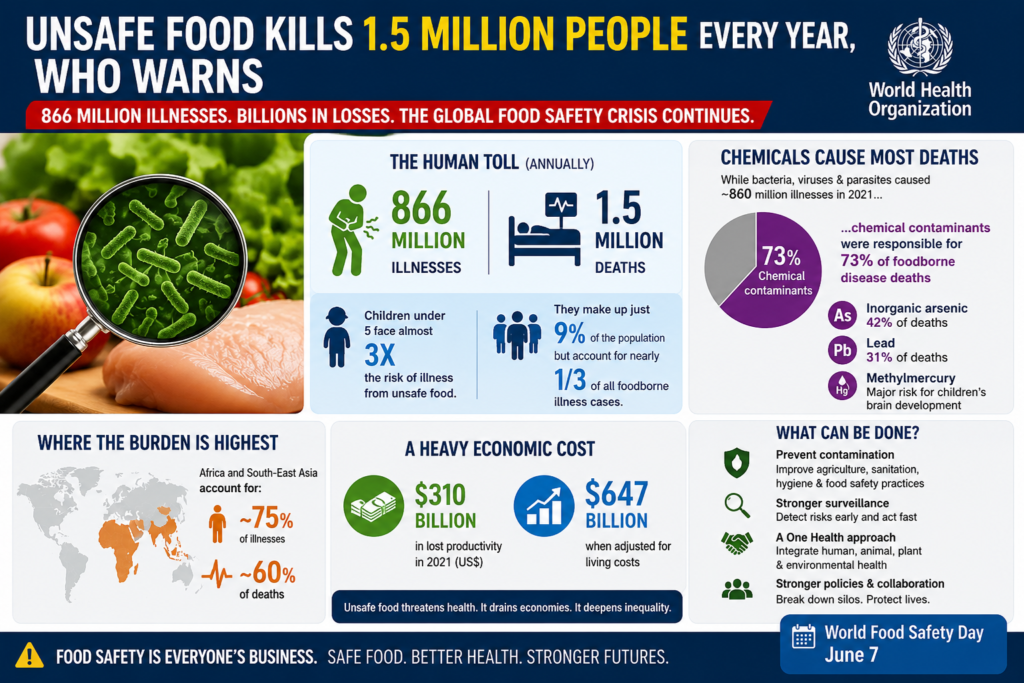
Unsafe food continues to pose one of the world’s most significant public health challenges, causing an estimated 866 million illnesses and 1.5 million deaths annually, according to a major new analysis released by the World Health Organization (WHO).
The report, WHO’s most comprehensive assessment of foodborne diseases to date, evaluated 42 foodborne hazards across 194 countries between 2000 and 2021. The findings highlight the persistent burden of contaminated food on global health, economies, and vulnerable populations.
The report reveals that children under the age of five are among the most vulnerable victims of foodborne diseases. Although they represent only 9 percent of the global population, they account for nearly one-third of all foodborne illness cases worldwide.
According to WHO, young children face almost three times the risk of developing foodborne illness compared with older children and adults.
While bacteria, viruses, and parasites were responsible for approximately 860 million illnesses in 2021, chemical contaminants emerged as the leading cause of foodborne deaths.
WHO estimates that:
Together, arsenic and lead exposure were associated with more than one million deaths globally in a single year.
Although the global burden of foodborne diseases has declined since 2000, significant regional disparities remain.
Africa and South-East Asia continue to experience the highest burden, accounting for:
WHO attributes many of these cases to inadequate sanitation, poor hygiene, unsafe food handling practices, and limited access to healthcare.
Beyond the health consequences, unsafe food places a substantial burden on economies worldwide.
WHO estimates that foodborne diseases resulted in approximately US$310 billion in productivity losses in 2021 due to illness-related absenteeism and reduced workforce participation. When adjusted for purchasing power differences between countries, the economic impact rises to US$647 billion annually.
The report warns that several global trends are increasing food safety risks, including:
Experts caution that contaminants such as arsenic, lead, and methylmercury become extremely difficult to remove once they enter the food chain, making prevention critical.
WHO is urging governments to strengthen food safety systems through improved agricultural practices, stronger industrial controls, enhanced surveillance programs, and better environmental management.
The organization also advocates for a “One Health” approach that integrates human, animal, plant, and environmental health to address food safety risks comprehensively.
The findings serve as a reminder that food safety extends far beyond foodborne outbreaks and recalls. From microbial pathogens to chemical contaminants, unsafe food continues to affect millions of lives every year, highlighting the need for stronger prevention measures, regulatory oversight, and international collaboration to protect public health.
As the world prepares to observe World Food Safety Day on June 7, the report reinforces the message that safe food is not only a public health necessity but also a cornerstone of sustainable development and economic resilience.