
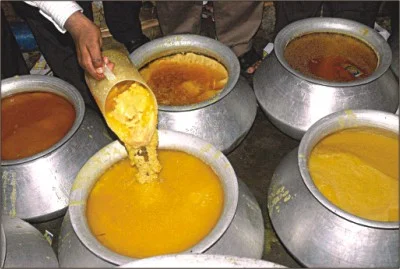
A dairy operation in Surat, Gujarat, has been exposed for allegedly manufacturing and selling adulterated desi ghee made from a mixture of cheaper vegetable oils and other substances. Police arrested 42-year-old Rajeshkumar Jayantibhai Patel in connection with the case after raiding Jai Yogeshwar Dairy on Ved Road.
The operation highlights ongoing concerns about food adulteration in India, particularly the sale of products marketed as pure ghee despite containing ingredients that do not belong in authentic dairy fat.
Acting on a tip-off, Surat Police and food safety officials raided the dairy premises and seized approximately 34.05 kg of suspected adulterated ghee, along with equipment and other materials valued at ₹43,535.
According to the available case details, the product was allegedly prepared using a combination of vanaspati, soybean oil, palmolein oil and turmeric before being sold as pure desi ghee. Authorities also alleged the misuse of a Food Safety and Standards Authority of India (FSSAI) licence.
Laboratory analysis reportedly detected turmeric and beta-sitosterol in the seized product. Beta-sitosterol is a plant-derived sterol commonly found in vegetable oils and is used in food analysis to help identify the presence of vegetable fats. Its detection can indicate that the fat composition is inconsistent with pure milk fat.
The reported findings raised concerns about the product’s authenticity and safety. Further investigation is underway to establish the full extent of the operation, identify other people who may have been involved and determine where the adulterated ghee was distributed.
Authentic desi ghee is produced from milk fat. Adulterating it with cheaper vegetable fats can mislead consumers about the product’s composition, quality and value.
The use of undeclared ingredients also creates a transparency problem, particularly when products are sold under claims such as “pure” or “shuddh ghee.” Consumers may have no reliable way to determine the actual composition of such products through appearance, colour or smell alone.
The health risks depend on the substances used, their quality, the presence of contaminants and the extent of exposure. Vegetable oils are not inherently unsafe, but their undeclared use in a product represented as pure ghee constitutes a significant authenticity and food-compliance concern. Any additional unsafe substances or contamination could create further risks.
The Surat case follows another major enforcement action in Gujarat reported by NDTV in September 2025. In that incident, the state’s Food and Drugs Control Administration seized more than 5 tonnes of suspected spurious ghee, valued at approximately ₹35 lakh, from an illegal storage facility in Banaskantha district. The facility was reportedly operating without a valid FSSAI licence, and samples were sent for laboratory testing.
The two cases illustrate the scale of enforcement challenges surrounding adulterated dairy products, from smaller manufacturing operations to large storage facilities. Food safety authorities continue to conduct inspections and collect samples to identify suspected violations involving commonly adulterated products such as ghee, milk and paneer.
The investigation into Jai Yogeshwar Dairy is ongoing. Authorities are expected to examine the supply chain and distribution of the seized product to determine whether other businesses or consumers were affected.
The case also underscores the importance of laboratory testing, effective licensing oversight and traceability in preventing food fraud. For consumers, the central concern is not simply whether a product is labelled as pure ghee, but whether its composition meets the applicable food safety and quality standards.