
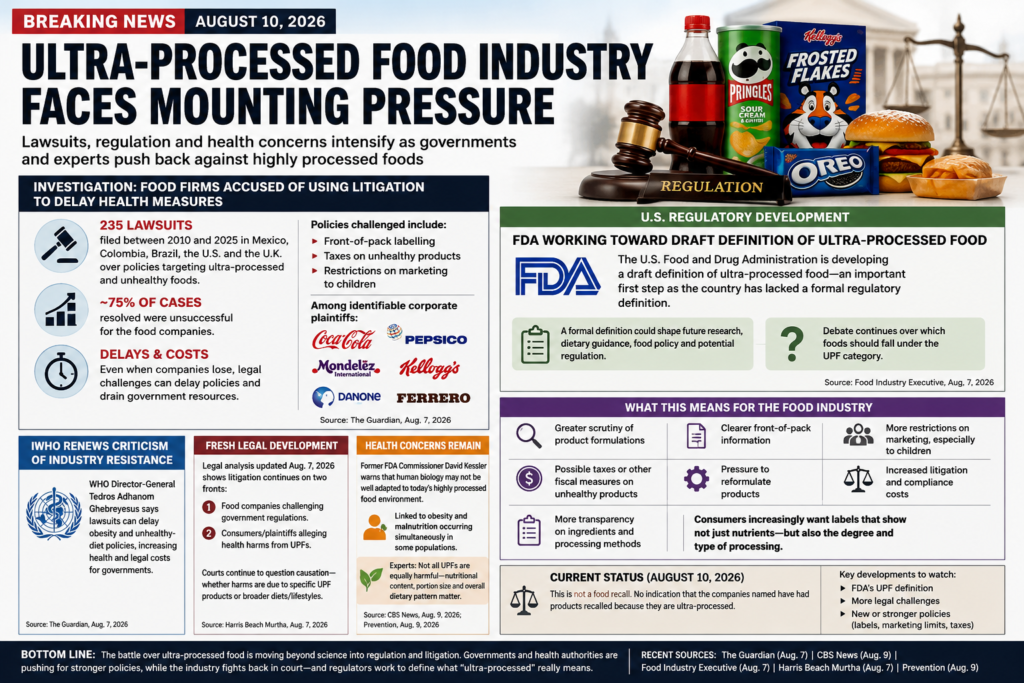
Major ultra-processed food (UPF) manufacturers are facing increasing scrutiny as governments, health experts and regulators intensify efforts to address the growing consumption of highly processed foods.
The latest developments come amid renewed attention to the industry’s use of litigation to challenge public-health measures, alongside moves in the United States toward a formal regulatory definition of ultra-processed food. Recent reporting and legal analysis published over the past few days suggest that the debate is shifting from whether UPFs should be addressed to how governments should regulate them and how the food industry will respond.
A recent investigation highlighted the scale of legal challenges brought by food companies and industry groups against government measures designed to reduce unhealthy-food consumption.
According to the investigation, 235 lawsuits were filed between 2010 and 2025 in Mexico, Colombia, Brazil, the United States and the United Kingdom over policies targeting ultra-processed and unhealthy foods. The measures involved areas including front-of-pack labelling, taxes on unhealthy products and restrictions on marketing.
The investigation found that around three-quarters of resolved cases were unsuccessful for the food companies. However, health-policy advocates argue that litigation can still have an impact even when companies ultimately lose, because legal challenges can delay implementation and consume government resources.
The latest commentary published on August 7 argued that the industry’s legal strategy could function as a means of slowing regulation rather than simply winning individual cases. The analysis compared the approach with historical tactics used by other heavily regulated industries, although such comparisons remain contested.
Among identifiable corporate plaintiffs in the investigation were major international food and beverage companies including Coca-Cola, PepsiCo, Mondelēz, Kellogg’s, Danone and Ferrero.
The litigation issue has also drawn criticism from the World Health Organization.
WHO Director-General Tedros Adhanom Ghebreyesus has argued that legal challenges to obesity and unhealthy-diet policies can delay public-health protections and impose additional legal and healthcare costs on governments.
The WHO’s concern comes as obesity remains a major global health issue and consumption of highly processed foods remains substantial in several high-income countries.
A separate development reported on August 7 is particularly significant for the food industry: the U.S. Food and Drug Administration has been working toward a draft definition of ultra-processed food.
The move is important because there has historically been no single universally accepted regulatory definition of UPFs in the United States. A formal definition could influence future research, dietary guidance, food policy and potentially regulatory approaches to products considered ultra-processed.
The development comes as U.S. authorities continue to examine the relationship between highly processed foods and chronic disease. The question of which foods should actually fall under the UPF category remains contentious, particularly because some foods classified as ultra-processed can still provide important nutrients.
The latest public discussion has also highlighted an important scientific distinction.
The term ultra-processed food covers a very broad range of products. Some are clearly high in added sugar, sodium, saturated fat or calories, while others can contain useful nutrients such as protein, fibre or vitamins.
Recent nutrition commentary therefore stresses that processing level alone does not necessarily determine whether a food is nutritionally poor. The nutritional composition, portion size, overall dietary pattern and frequency of consumption also matter.
This is one of the major criticisms surrounding broad UPF regulation: a blanket approach could potentially group nutritionally different products together.
A legal analysis updated on August 7, 2026 reported that litigation involving ultra-processed food manufacturers is continuing despite significant scientific and legal challenges.
The development illustrates that the controversy is occurring on two separate legal fronts:
The legal challenges face significant questions surrounding causation—particularly whether specific health outcomes can be directly attributed to individual UPF products rather than broader dietary and lifestyle factors.
Fresh coverage on August 9 also brought renewed attention to concerns about the biological effects of highly processed diets. Former FDA Commissioner David Kessler warned in a CBS interview that human biology may not be well adapted to the highly processed food environment that has developed over recent decades. The discussion linked the issue to obesity and malnutrition occurring simultaneously in some populations.
At the same time, nutrition experts continue to caution that the evidence should not be interpreted as meaning every food classified as UPF is inherently harmful. The strongest concern remains concentrated around diets heavily dominated by energy-dense, highly palatable foods that are high in added sugars, unhealthy fats and sodium and relatively low in fibre and other beneficial nutrients.
The developments of the past few days indicate that the UPF issue is moving into a more consequential regulatory phase.
For food manufacturers, the potential consequences include:
For consumers, the debate is increasingly focused on whether food labels should communicate not only nutrient content, but also the degree and type of processing used to manufacture a product.