
By Sumesh T. Maharaj & Mansi Nautiyal
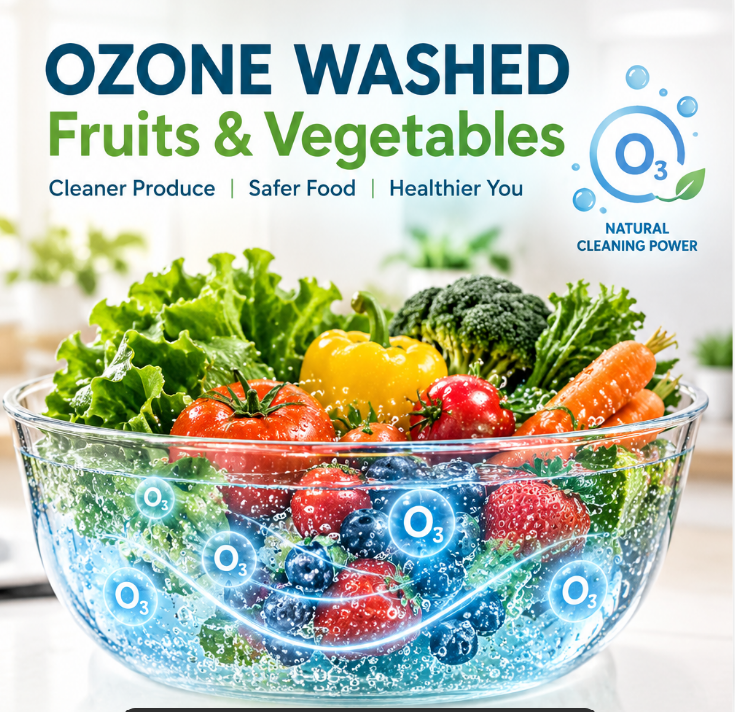
Ozone treatment is emerging as a promising food-safety technology that can reduce microbial contamination and certain pesticide residues. But how effective is it in practice, and can it replace conventional washing? Recent scientific research offers a more nuanced answer.
Fresh fruits and vegetables are essential components of a healthy diet, providing vitamins, minerals, dietary fibre and other beneficial compounds. However, before reaching consumers, these foods pass through several stages, including cultivation, harvesting, transportation, storage and retail handling. Contamination can occur at any point along this journey.
Soil, irrigation water, animal waste, contaminated handling equipment and unhygienic food preparation practices can introduce harmful microorganisms onto fresh produce. These may include Escherichia coli (E. coli), Salmonella and Listeria monocytogenes, which are associated with foodborne illness. Fruits and vegetables may also carry pesticide residues, dirt and other environmental contaminants.
Washing produce under running water is an important food-safety practice. However, conventional washing does not eliminate every microorganism or remove every pesticide residue, particularly when contaminants are firmly attached to the surface or lodged in crevices.
This has encouraged interest in alternative washing and disinfection technologies. One such approach is ozone washing, which uses ozone dissolved in water to help reduce microbial contamination and, under suitable conditions, degrade certain chemical residues.
Scientific interest in this technology has continued to grow. A 2024 meta-analysis examined the antimicrobial effectiveness of different ozonated-water washing methods, while reviews published in 2025 explored ozone applications in post-harvest preservation, food quality and pesticide-residue reduction.
However, the central question is not simply whether ozone can kill microorganisms. It is whether the treatment can do so consistently, without compromising food quality, and under conditions that are safe and practical for consumers and food businesses.
Ozone washing is a produce-treatment technique that uses ozone (O₃), a highly reactive form of oxygen, to help reduce microbial contamination and degrade certain unwanted compounds.
Unlike ordinary oxygen, which contains two oxygen atoms, an ozone molecule contains three. This structure makes ozone a powerful oxidising agent capable of reacting with biological molecules and a range of chemical compounds.
Ozone is generated using specialised equipment, commonly through an electrical discharge that converts oxygen in air or an oxygen supply into ozone. The gas can then be dissolved in water to produce ozonated water, which is used to treat fruits and vegetables.
The technology can be applied in several ways:
Each method has different operating requirements and may produce different results. Effectiveness depends on factors such as ozone concentration, contact time, water quality, temperature, the type of produce and the nature of the contaminant.
Ozone washing is therefore not a single standardised process. It is a group of technologies whose performance depends on how they are designed and operated.
The primary mechanism behind ozone washing is oxidation. When ozone comes into contact with microorganisms or susceptible chemical compounds, it reacts with their molecular structures and can alter or damage them.
Bacteria and other microorganisms rely on intact cell membranes, proteins and other cellular components to survive. Ozone can oxidise these structures, interfere with essential cellular functions and ultimately inactivate susceptible microorganisms.
This mechanism makes ozone a potential tool for reducing the microbial load on fresh produce, including contamination associated with pathogens such as E. coli, Salmonella and Listeria.
However, the degree of inactivation varies. Some microorganisms may be more resistant to a particular treatment, while surface irregularities, organic matter and inaccessible areas can protect others from exposure.
A reduction in microbial numbers is therefore not equivalent to complete sterilisation.
Ozone can also react with some pesticide molecules, changing their chemical structures through oxidation.
This is important because pesticide residues vary considerably in their chemical properties. Some compounds react relatively readily with ozone, while others are less susceptible under the same treatment conditions.
The effectiveness of ozone therefore depends on the pesticide involved, the amount present, the produce surface and the treatment conditions.
A decline in the concentration of the original pesticide does not automatically establish that every resulting reaction product is harmless. Assessing the safety of treated produce may also require identifying and evaluating relevant transformation products.
Ozone is unstable and decomposes over time, ultimately forming ordinary oxygen. This means that properly controlled ozone treatment can avoid leaving the persistent sanitiser residues associated with some other treatment approaches.
However, saying that ozone itself decomposes into oxygen is not the same as proving that every reaction involving ozone produces harmless compounds. The chemistry of the particular contaminants being treated still matters.
This distinction is especially important when evaluating broad claims that ozone makes food completely free of chemicals.
Research published in 2024 and 2025 provides useful evidence about ozone washing, while also highlighting why its performance should not be generalised across every fruit, vegetable or contaminant.
A meta-analysis published in Foods on 3 December 2024 compared the antimicrobial effectiveness of different ozonated-water treatment methods used to wash fresh produce.
The researchers examined three approaches: stationary pre-ozonated water, agitated pre-ozonated water and ozone sparging, in which ozone gas is continuously introduced into water.
The analysis found that the sparging method produced the greatest microbial reduction among the methods assessed.
This finding highlights an important practical consideration: simply adding ozone to water may not be enough. How ozone is introduced, transferred and maintained during washing can influence the results.
The study also identified a major challenge for the technology: ozone’s antimicrobial performance can be inconsistent under different experimental and treatment conditions.
Consequently, the results of one laboratory experiment cannot automatically be applied to a household appliance, a commercial washing line or every type of produce.
A study published in the Journal of Food Composition and Analysis in October 2025 examined ozone treatment for reducing residues of acetamiprid, a pesticide, in bell peppers, cucumbers, tomatoes and parsley.
The researchers reported acetamiprid-residue reductions of approximately 51–90% following treatment with ozonated water, compared with approximately 4–47% after dipping in distilled water. These ranges reflect the treatments and vegetables investigated in that study.
The researchers also reported that vitamin C and total phenolic compounds were not significantly affected in most of the vegetables tested under the study conditions.
These findings suggest that ozonated water can improve the removal or degradation of certain pesticide residues compared with water alone. Nevertheless, the results do not establish that ozone removes all pesticides or that identical reductions would occur in ordinary household washing.
The study focused on one pesticide and a limited selection of vegetables. Its findings should not be interpreted as a universal removal rate.
A review published online in July 2025 in Food Reviews International assessed research on ozone treatment for preserving fruits and vegetables after harvest.
Drawing on 195 selected publications, the review discussed ozone applications, microbial control, pesticide degradation, food-quality changes and regulatory considerations.
It identified promising applications for ozonated water, gaseous ozone and ozonated mist. It also highlighted the importance of controlling treatment concentration, exposure time and produce sensitivity.
The review emphasised that poorly optimised treatment can damage produce quality. Excessive exposure may affect colour, texture and sensitive nutritional compounds, depending on the food and treatment conditions.
Taken together, these studies indicate that ozone is a promising food-processing technology, but its effectiveness must be demonstrated for the specific product, contaminant and intended use.
One of the principal reasons for using ozone is its ability to inactivate microorganisms.
In commercial food processing, microbial control is particularly important when large volumes of fruits and vegetables are washed, cut, packed or prepared for consumption without further cooking.
A well-designed ozone treatment can help lower the microbial load and may provide an additional control measure against contamination. It can also be useful in managing the quality of wash water under appropriately validated processing conditions.
However, its performance depends on adequate exposure and effective contact with contaminated surfaces. Microorganisms hidden in damaged tissue, crevices or other protected locations may survive.
Ozone treatment should therefore form part of a broader food-safety system rather than being treated as a stand-alone guarantee.
Pesticide residues are another reason researchers are investigating ozone washing.
Because ozone reacts with susceptible chemical compounds, it can help degrade certain pesticide residues on produce. Depending on the pesticide and treatment conditions, this may offer an advantage over water washing alone.
Nevertheless, pesticide reduction is not uniform. The chemical properties of the pesticide, its location on or within the produce, the contact time and the ozone concentration can all influence the outcome.
Washing cannot be assumed to eliminate systemic pesticides, which may be present within plant tissues, or to remove every pesticide residue to a safe level.
Consumers should continue to follow standard washing practices and rely on appropriate agricultural controls and regulatory monitoring to manage pesticide risks.
Ozone has also been investigated for its potential to slow spoilage and extend the storage life of selected fruits and vegetables.
Spoilage microorganisms contribute to softening, discolouration, unpleasant odours and decay. Reducing their numbers may help maintain the quality of some produce during storage.
Ozone can also influence certain biological processes associated with ripening and deterioration. Under appropriate conditions, these effects may help preserve quality for longer.
However, shelf-life extension is not guaranteed. Results differ by commodity, treatment method, storage temperature, humidity and packaging conditions. An unsuitable ozone dose may instead damage the produce and reduce its marketable quality.
An important feature of ozone is its instability. After treatment, ozone decomposes over time rather than behaving like a persistent coating on produce.
This can make ozone attractive for food-processing applications where operators want microbial control without leaving a lasting sanitiser residue.
However, residue-free treatment should not be confused with contaminant-free food. Ozone decomposition does not reverse every possible chemical reaction or establish that all pesticide transformation products are safe.
Ozone can be generated when needed and may reduce dependence on some conventional chemical sanitisers in suitable applications.
Because ozone decomposes, it may also offer advantages in terms of persistent chemical residues. In food-processing facilities, its environmental performance depends on the complete treatment system, including energy requirements, water use, equipment, ventilation and wastewater management.
It is therefore more accurate to describe ozone as a potentially useful, lower-residue sanitisation technology than to assume it is automatically the most environmentally friendly choice in every setting.
Claims of 90%, 97.6% or even 99.9% contaminant removal can be attractive to consumers, particularly when associated with household produce-cleaning devices.
However, a percentage reduction is meaningful only when the contaminant, test method, treatment conditions and study results are clearly specified.
For example, a device tested against one pesticide under controlled laboratory conditions may produce a different result from the same device used on a different pesticide or a different type of produce.
Similarly, a reduction in bacterial counts does not establish that every harmful pathogen has been eliminated.
Before accepting a product’s performance claims, consumers should look for independent testing that identifies:
The same principle applies to household appliances combining ozone with ultrasonic waves. Ultrasound may help dislodge surface contaminants in certain applications, but claims about the combined system must be supported by testing of the actual device.
A general statement that an appliance removes a high percentage of “toxins” is not sufficient evidence of its overall food-safety performance.
Ozone and conventional washing serve related but different purposes. Ordinary running water helps remove dirt and some surface contamination, while ozone adds a chemical oxidation step intended to inactivate microorganisms and react with susceptible compounds.
The following comparison describes their general characteristics rather than a universal ranking.
| Feature | Running-water washing | Ozonated-water treatment |
|---|---|---|
| Removal of visible dirt | Helps remove soil and debris | Can remove dirt while treating the produce |
| Microbial control | Reduces some surface microorganisms | Can provide additional microbial inactivation under suitable conditions |
| Pesticide residues | May remove some surface residues | May degrade certain pesticides more effectively, depending on the compound |
| Persistent sanitiser residues | No sanitiser is added | Ozone decomposes, although reaction products still require consideration |
| Equipment requirements | Minimal | Requires ozone-generating and treatment equipment |
| Household suitability | Widely recommended for routine washing | Depends on validated device performance and safe operation |
| Complete decontamination | Not guaranteed | Not guaranteed |
The most important distinction is that ordinary washing remains an essential baseline practice. Ozone is a potential additional treatment, particularly in commercial operations where its performance can be monitored and validated.
Sources:
1. https://www.mdpi.com/2304-8158/13/23/3906
2. https://doi.org/10.1080/87559129.2025.2525424
3. https://doi.org/10.1016/j.jfca.2025.107975
4. https://www.fda.gov/food/buy-store-serve-safe-food/selecting-and-serving-produce-safely
5. https://www.ecfr.gov/current/title-21/chapter-I/subchapter-B/part-173/section-173.368
6. https://www.epa.gov/indoor-air-quality-iaq/ozone-generators-are-sold-air-cleaners
7. https://www.fssai.gov.in/inspection/hygiene-requirements
8. https://pubmed.ncbi.nlm.nih.gov/39413726/
9. https://pmc.ncbi.nlm.nih.gov/articles/PMC13258465/