
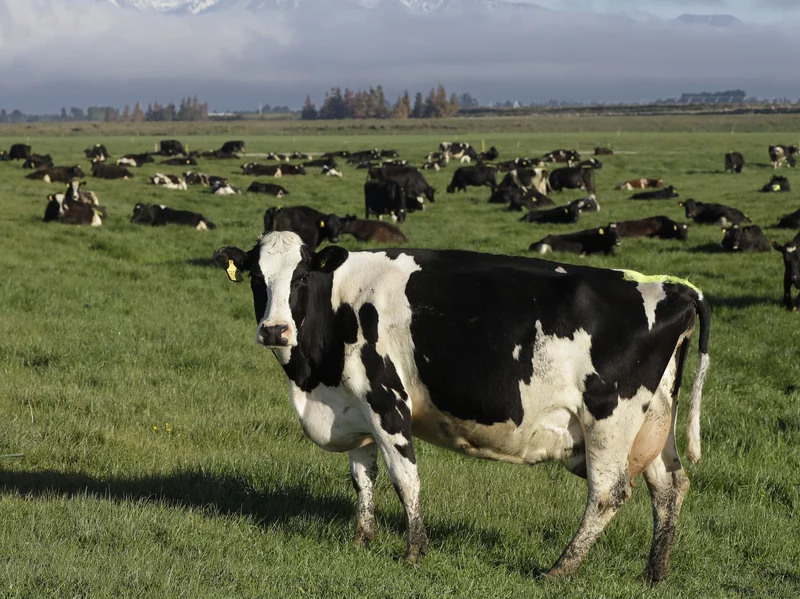
The government of New Zealand on Tuesday suggested charging the greenhouse gases that farm animals produce when they urinate and burp as part of a strategy to combat climate change. This proposed additional levy on livestock farmers may increase the price of meat, milk, and related animal products in the future. Consumers are globally stressed due to the skyrocketing rise in food prices in supermarkets. Other countries may also follow New Zealand’s proposal may cause a crisis livestock sector and may permanently leave their traditional job of livestock farming. Livestock manure is cheap and mainly used to replace chemical fertilizers to produce crops and vegetables. This levy indirectly causes replacing natural manure with chemical fertilizers for growing crops and vegetables.
The government said that the farm levy would be a first in the world and that farmers should be able to recover the expense by raising the price of items that are environmentally friendly. 26 million sheep and roughly 10 million cattle are present in New Zealand. Agriculture is responsible for over half of the nation’s overall greenhouse gas emissions, primarily methane, yet agricultural emissions have historically been exempt from the country’s trading program.
In a first for the world, New Zealand may soon implement a policy requiring farmers to pay for their agricultural greenhouse gas emissions, including the nitrous oxide and methane that livestock urine and belches emit. Farmers quickly criticized the plan. The idea would “tear the guts out of small-town New Zealand,” according to Federated Farmers, the industry’s leading lobbying group, and replace farms with trees.
According to Andrew Hoggard, president of Federated Farmers, farmers have been working with the government for more than two years to develop an emissions reduction strategy that won’t reduce food production. Hoggard stated, “Our objective was to keep farmers farming. As opposed to that, he claimed that farmers would sell their land “so quickly you won’t even hear the dogs barking on the back of the ute (pickup truck) as they drive off.”
The plan, according to opposition MPs from the conservative ACT Party, would actually raise global emissions by shifting farming to nations that were less effective at producing food. According to Andrew Hoggard, president of Federated Farmers, farmers have been working with the government for more than two years to develop an emissions reduction strategy that won’t reduce food production.
Hoggard stated, “Our objective was to keep farmers farming. As opposed to that, he claimed that farmers would sell their land “so quickly you won’t even hear the dogs barking on the back of the ute (pickup truck) as they drive off.”
The plan, according to opposition MPs from the conservative ACT Party, would actually raise global emissions by shifting farming to nations that were less effective at producing food. The discussion regarding farming’s effects on the environment and the efforts some claim are required for mitigation is a topic of discussion that is being discussed on a more global scale outside of New Zealand.
Farmers in the Netherlands have driven tractors along busy highways and dropped hay bales on the ground to protest government proposals to reduce harmful pollutant emissions. By 2050, the New Zealand government intends to cut greenhouse gas emissions and achieve carbon neutrality. A commitment to cut farm animal methane emissions by 10% by 2030 and up to 47% by 2050 is a part of that plan.
Farmers would begin paying for emissions under the government’s proposed scheme in 2025, though the pricing has not yet been decided. All of the money raised from the planned farm levy, according to Prime Minister Jacinda Ardern, will be reinvested in the sector to finance new technologies, research, and incentive payments for farmers.
According to Ardern, New Zealand’s farmers are on track to reduce agricultural emissions before anyone else in the world, giving us a competitive edge in a global market where consumers are becoming more sensitive about the source of their food. Farmers are already feeling the effects of climate change, according to O’Connor, who noted that droughts and floods are occurring more frequently. Leading on agriculture emissions benefits our economy and the environment.
The liberal Labor government’s idea is reminiscent of a previous Labor administration’s 2003 attempt to charge farm animals for their methane emissions, which was also unsuccessful. Farmers at the time fiercely resisted the proposal, and political opponents mocked it as a fart tax. The plan was ultimately dropped by the administration.
Since Ardern won a second term in office in 2020 with a landslide vote of historic proportions, opinion polls show that Ardern’s Labor Party has lost support and distanced itself from the main opposition National Party. Farmers in New Zealand have significant political influence, so if Ardern’s government can’t come to an agreement with them on the idea, it will probably be more challenging for Ardern to win reelection when the country goes to the polls again the following year.
According to a significant new study, a third of all the planet-warming gases released by human activity is caused by the world’s food industry, with the production of meat from animals polluting the environment twice as much as that of plant-based diets. The entire system of food production, including the use of farming equipment, fertilizer application, and product transportation, results in 17.3 billion metric tonnes of greenhouse gas emissions annually. According to studies, this massive release of gases that contribute to the climate issue is equivalent to 35% of all worldwide emissions and more than double the US’s total emissions.
Grazing animals require a lot of land, which is often cleared through the felling of forests, as well as vast tracts of additional land to grow their feed. The paper calculates that the majority of the world’s cropland is used to feed livestock, rather than people. Livestock also produces large quantities of methane, a powerful greenhouse gas.
The study discovered that 29% of all food production emissions come from the growth of plant-based foods, with 57% of emissions coming from the use of cows, pigs, and other animals for food as well as livestock feed. The remainder is derived from various land uses, such as those cotton or rubber. A fifth of the emissions caused by raising and growing food are created just by beef.
“All of these things combined mean that the emissions are very high,” said Xiaoming Xu, another University of Illinois researcher and the lead author of the paper. “To produce more meat, you need to feed the animals more, which then generates more emissions. You need more biomass to feed animals in order to get the same number of calories. It isn’t very efficient.”
Scientists have repeatedly emphasized the need for a significant change in agricultural and eating practices if hazardous global warming is to be avoided. There are now roughly three hens for every person on the earth thanks to the expansion of meat manufacturing.