
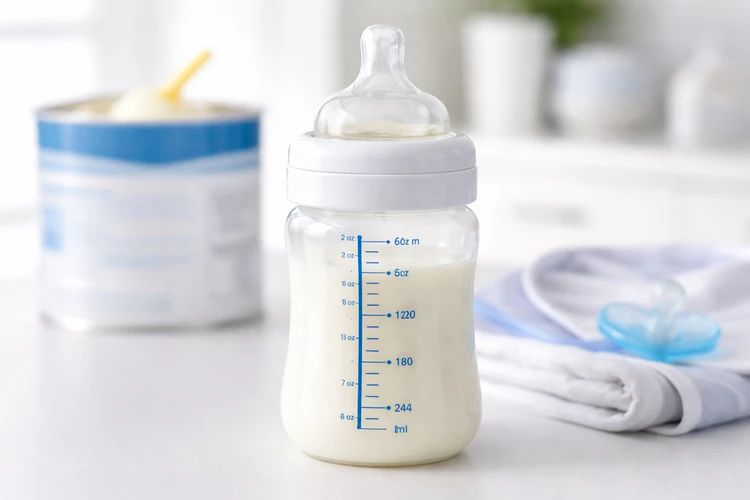
Shares of global dairy giants Danone and Nestlé fell sharply on Monday after a widening recall of infant formula linked to potential contamination raised concerns over significant financial and reputational damage across the tightly regulated infant nutrition sector.
The recalls were initiated after French baby food company Vitagermine expanded a precautionary recall of infant milk powder over concerns that an ingredient may be contaminated with cereulide, a toxin produced by Bacillus cereus. The issue has so far affected four manufacturers, including three of the world’s largest dairy groups—Nestlé, Danone, and privately owned Lactalis.
Danone shares closed 2.3% lower, having fallen as much as 6% in early trading, marking their lowest level since January 2025. Nestlé shares also declined, closing 0.9% lower after dropping up to 3% during morning trade, reaching a five-month low. Nestlé’s stock has fallen nearly 9% this month, following recalls of infant formula batches across dozens of countries earlier in January.
Analysts warn that the financial consequences of the recalls could be substantial. According to Barclays, the potential impact on Nestlé could be around ten times greater than that on Danone. In a worst-case scenario, Danone could face losses of up to €100 million ($118.54 million), while Nestlé’s losses could approach 1 billion Swiss francs ($1.29 billion).
Infant formula represents a significant portion of Danone’s business, accounting for approximately 21% of its group revenue, according to Bernstein analysts. For Nestlé, the segment is smaller but still material, contributing an estimated 5% of total revenue.
The recalls underscore how a single compromised ingredient can quickly spread across the infant nutrition supply chain, triggering swift regulatory action and market volatility. Cereulide contamination was traced to an ingredient sourced from a supplier, prompting authorities to investigate its distribution across multiple manufacturers.
French investigators are currently examining whether there is a potential link between the recalled formula products and the deaths of two infants. While no definitive conclusions have been drawn, the investigation has intensified scrutiny of the supply chain.
France’s agriculture ministry stated that the affected ingredient originated in China and was sold by a Dutch company, though no specific firms were named. Ireland’s Food Safety Authority confirmed last week that cereulide had been detected in arachidonic acid oil manufactured in China, which is commonly used in infant formula.
Danone confirmed it is cooperating with regulators in Singapore, where authorities had earlier blocked batches of infant formula over contamination concerns. The company also announced recalls of certain batches after Irish regulators said products manufactured in Ireland had been exported to other European countries.
Separately, Vitagermine said on Monday that it had recalled three specific batches of its Babybio infant formula as a precautionary measure.
The unfolding situation highlights the vulnerability of the global infant nutrition industry, where safety concerns can rapidly escalate into cross-border recalls with major financial consequences. As investigations continue, manufacturers and regulators alike remain on high alert to prevent further risks to infant health and to restore consumer confidence.