
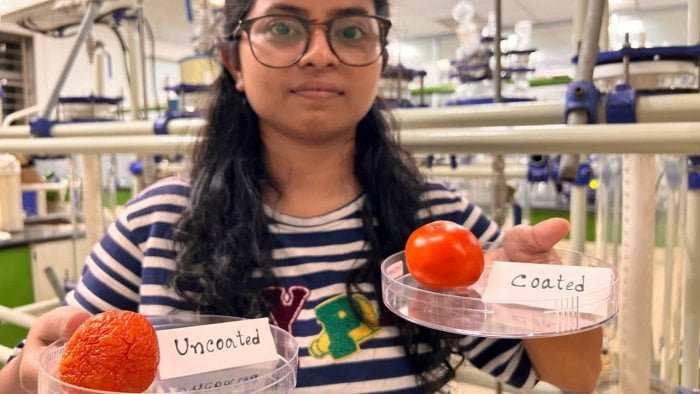
Indian scientists from IIT Guwahati have created a non-toxic, edible coating that was found to increase the shelf life of fruits and vegetables during laboratory tests. They have created an edible coating that can increase the shelf life of fruits and vegetables. The coating, which is intended to avoid food waste, can keep the produce fresh for a lot longer than it could without it, according to the researchers.
On a variety of fruits and vegetables, including potatoes, tomatoes, green peppers, strawberries, mandarin oranges, apples, pineapples, and kiwis, they tested the coating. It can extend the shelf life of fruits and vegetables by up to two months. For instance, when stored at room temperature, covering ripe tomatoes enhanced their shelf life by nearly one month compared to uncoated tomatoes. Strawberries are also difficult to keep fresh for longer than five days. Vimal Katiyar told that ripe strawberries may be kept fresh for more than 20 days if they are coated.
Micro-algae extract and polysaccharides were combined to create the specialized covering. The extract comes from Dunaliella tertiolecta, marine microalgae that are frequently utilized as a source of algal oil, a dietary supplement, and a plant-based substitute for fish oil. Typically, a byproduct of the extraction of algal oil is thrown away.
To create their film coating, Katiyar and his team employed extracts from this residue. The leftover material was mixed with chitosan, a substance created by processing the shellfish’s exoskeleton, to create an edible film. Based on the fruits and vegetables they have been using over the past six years, Katiyar and his team have developed many versions of these coatings.
The coating can be applied by the end-user without the need for specialized equipment or training. These are fairly straightforward solutions that are simple to implement. Such produce handling techniques were previously regularly utilized by farmers, according to Katiyar.
By applying these coatings to BHK-21 cells, the researchers tested the coatings’ biosafety. These cells are employed in toxicological investigations and are generated from the kidneys of young hamsters. The results of these tests allowed the scientists to draw the conclusion that the materials are safe to use as a coating for edible items. Katiyar did not address whether research is necessary to determine the coating’s long-term effects on health.
Furthermore, Katiyar did not address the material’s current price but did state that it is prepared to be made into a commercial product. “With the assistance of industries, they are now prepared to take it to a commercial scale. In order to increase farmers’ incomes. I would like to ask the industries to help bring this important innovation to the market so that it can enhance farmers’ incomes,” he added.