Concern over food waste is expanding globally. Food is wasted for a variety of reasons, including high serving sizes, patron rejection, and poor produce. Best before labels are gaining prominence as people’s awareness of the issue of food waste increases.
Manufacturers have been using date labels extensively since the 1970s to allay consumer concerns about the product’s freshness. Manufacturers are free to choose the times when they think their products would taste the greatest because there are no federal regulations guiding them. Only infant formula must have a “use by” date in the US. Since 2019, 80% of US food is subject to FDA regulation. It advises producers to use the labels “use by” for perishable goods and “best if used by” for freshness.
Best-before dates will take the place of use-by dates on these dairy lines at both supermarkets, which designate when food is dangerous to consume. These indicate a window of time when things are still safe to eat, despite being a little less fresh.
Every year, 17% of the food produced worldwide is wasted; in the US, that percentage rises to 35%. UK shops are removing “best before” labels off pre-packaged fruit and vegetables, and the EU is considering banning them, due to consumer confusion over the safety of the product.
Food wastage is becoming a global concern, and one culprit, in particular, is coming under scrutiny: “best before” labeling. Manufacturers have been estimating peak freshness using labels for decades. “Best before” labels, in contrast to “use by” labels, which are present on perishable items like meat and dairy products, has nothing to do with food safety and may persuade customers to throw away food that is completely okay to consume.
“People read these dates and then they assume that it’s bad, they can’t eat it, and they toss it,” says Patty Apple, a manager at Food Shift, a California non-profit that collects and uses expired or flawed foods. “These dates don’t actually mean that they’re not edible or that they’re not still nutritious or tasty.”
Major British supermarket chains like Waitrose, Sainsbury’s, and Marks & Spencer recently did away with “best before” labels from pre-packaged fruit and vegetables as a solution to the issue. By the end of the year, the European Union is anticipated to publish a revision to its labelling regulations; it is also thinking about doing away with “best before” labels entirely.
There is no comparable initiative to eliminate “best before” labelling in the US. However, there is rising support for standardizing date labels to assist educate consumers about food waste. This support includes initiatives from major food corporations and supermarket chains as well as bipartisan legislation in Congress.
The majority of food waste in the European Union—more than 50%—occurs in residential homes. However, there are plans to significantly lower that.
The European Commission will put forth legally-binding targets for reducing food waste to be in place by 2023 as part of the Farm to Fork Strategy’s action plan. These initiatives, in particular, aim to alter EU regulations on date-marking such as “Use By” and “Best Before” dates to prevent the needless waste of food that has been connected to a misinterpretation of their meaning.
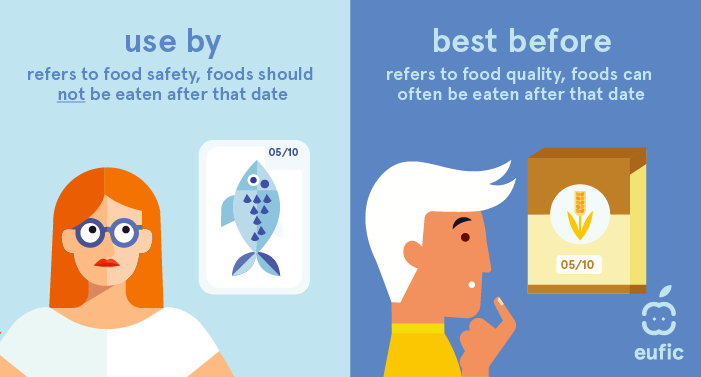
The project organizer, Toine Timmermans, says that research has revealed that roughly 50% of European customers are unclear about the significance of these labels. We found that in the Netherlands, misinterpretations of date labels account for around 15% of household waste. Therefore, we launched the campaign to describe the distinction between the two date labels, “Use By” and “Best Before.”
“Use By”: you must consume it before to the specified date. and only the quality is guaranteed by “Best Before.” In order to determine whether it is still safe to consume, you can then utilize your own senses to smell and taste the food.”
According to UN estimates, families account for the majority of 17% of the world’s annual food waste. According to ReFED, up to 35% of food supplied in the US is wasted. This results in a significant amount of wasted energy, including the water, land, and labour used in food production, as well as higher greenhouse gas emissions when leftover food is disposed of in landfills.
“Most people think you can’t consume something if it says sell by,’ ‘best by,’ or ‘expiration. That’s not correct at all, claims Richard Lipsit, owner of a Pleasanton, California-based Grocery Outlet business that specialises in cheap food.
Milk can be safely consumed up to a week after its “use by” date, according to Lipsit. According to Gunders, many packaged items, including canned goods, can be safely consumed for years after their “best before” date. To assess if food is safe to eat, the United States Food and Drug Administration advises people to watch for changes in color, consistency, or texture.
When food has gone past the limit of being edible, “our bodies are quite well suited to distinguish the signals of deterioration,” claims Gunders. We no longer have faith in those senses; instead, we have faith in these dates.
Customers are explicitly encouraged to engage their senses by a few UK grocery businesses. In January, Morrisons changed the “use by” dates with “best before” labels on the majority of their store-brand milk products. Another grocery store chain, Co-op, made the identical changes to its store-brand yoghurts.
Some customers are in favor of the reform. When she can, Falmouth, England social media marketer Ellie Spanswick purchases produce, eggs, and other groceries from farm stands and neighborhood stores. She claims that although the food doesn’t have labels, its freshness can easily be seen.
According to Spanswick, the last thing we need to be doing is squandering more food and money because a label on it indicates that it is no longer fit for human consumption.
Though not everybody concurs. Without labels, Ana Wetrov of London, who owns a home remodeling company with her husband, believes that personnel might not be aware of which things need to be taken off of shelves. She recently bought a pineapple, but she didn’t realize it was rotting in the center until she cut into it.
The “best if used by” and “use by” dates on some US chains’ store brands, such Walmart, have been standardized. Use of those labels is also encouraged by the Consumer Brands Association, which represents significant food corporations like General Mills and Dole.
According to Katie Denis, the association’s vice-president of communications, uniformity makes it much easier for our companies to create goods and maintain lower prices. American states have stepped in with their own laws in the absence of federal policy, aggravating grocery stores and the food industry.
Due to the misunderstanding, some businesses, like Unilever, are supporting legislation that would standardize US date labels and ensure that food could be donated to rescue organizations even after its quality date. This measure is presently being considered by Congress.
According to WRAP, behind potatoes and bread, milk is the food and drink item that is wasted most frequently in the UK. But due to the resources required for its production, it has the highest carbon footprint of all of these foods. According to Morrisons, one liter of milk can contribute up to 4.5kg of CO2. According to the UN Environment Programme, more than 900 million tons of food are wasted globally each year, which is equivalent to 8% to 10% of all carbon emissions. This indicates that a significant factor in climate change is food waste. Additionally, it contributes to the loss of biodiversity, pollution, and food shortages.
Even if addressing expiration date labels is such a minor portion of the overall problem of food waste, it can still have a significant influence, so we definitely need to pay more attention to them. Major UK stores have lately done away with best-before dates and are attempting to standardize date-label language to better inform consumers. States have stepped in with their own legislation for labeling products using “best by” and “use by” dates in the absence of Federal Policy. While addressing expiration date labels and food donation laws is a minor step, it will have a big impact. Clearer Labelling will assist to focus on small efforts like these.