
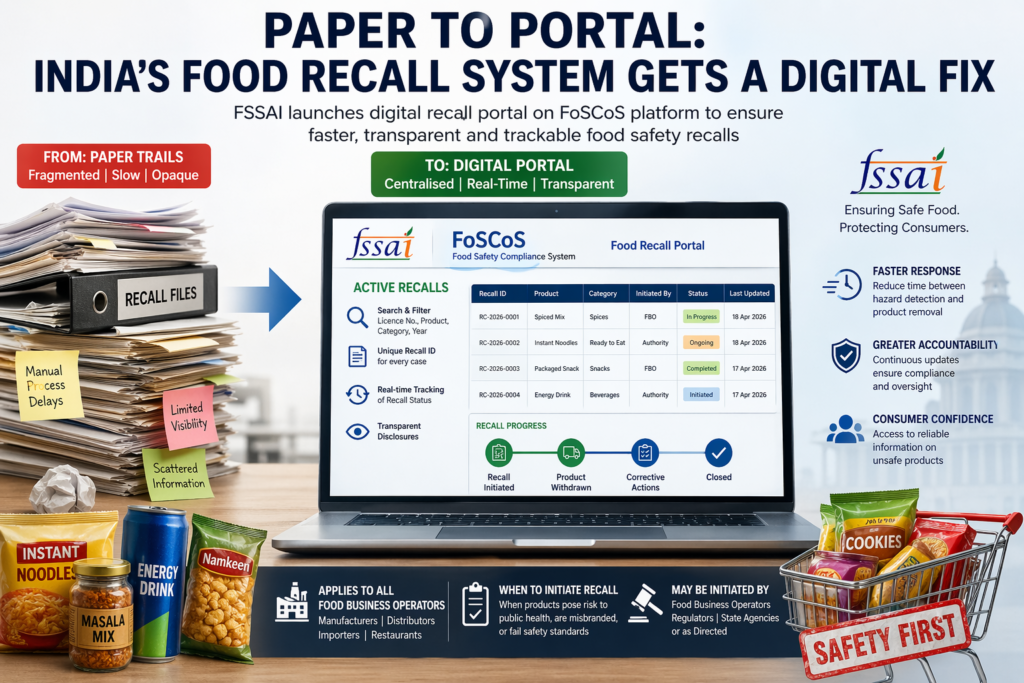
India’s food safety regulator, Food Safety and Standards Authority of India (FSSAI), has rolled out a dedicated digital food recall portal within its Food Safety Compliance System (FoSCoS) platform, marking a major shift in how unsafe food products are identified, tracked, and removed from the market.
Launched in March 2026, the new system replaces a fragmented, paper-based recall process with a centralized digital framework designed to improve speed, traceability, and transparency. The move comes amid growing concerns over delays and limited visibility in past recall actions across the country.
India has had food recall regulations in place for nearly a decade, requiring food business operators (FBOs) to maintain recall plans and report actions to regulators. However, implementation has often been inconsistent, with recalls managed through internal company processes and regulatory interventions without a unified tracking mechanism.
This lack of coordination became evident during high-profile incidents such as the Maggi noodles recall, where delayed communication and fragmented reporting highlighted systemic inefficiencies. Similar concerns resurfaced in more recent cases, including the 2024 recall of certain spice batches flagged for contamination risks, where visibility into execution remained unclear.
Under the updated framework, all recall actions—whether initiated by companies or directed by authorities—must be logged on the FoSCoS platform. Each case is assigned a unique identification number, enabling end-to-end traceability.
The portal allows users to:
Food businesses are required to continuously update the status of recalls, including corrective actions taken, creating a transparent audit trail accessible to regulators and, to some extent, the public.
The new rules apply across the food ecosystem, covering:
FBOs must initiate recalls when products pose risks to public health, involve mislabelling, or fail to meet safety standards. Recalls may also be triggered by directives from regulatory authorities or state agencies.
The digitisation of food recall processes significantly changes the compliance landscape:
For consumers, the system has the potential to improve awareness of unsafe products, while for regulators, it enables more efficient monitoring of recall effectiveness.
Despite its advantages, experts caution that digitisation alone cannot resolve deeper structural issues in India’s food safety ecosystem.
Key challenges remain:
While the digital portal strengthens downstream recall management, upstream issues such as detection, testing, and enforcement still require significant improvement.
With India’s food processing sector projected to reach substantial scale in the coming years, the need for robust and responsive food safety systems is becoming increasingly critical.
The new FoSCoS recall module represents an important step toward modernising regulatory oversight. However, its long-term success will depend on consistent compliance by food businesses, stronger enforcement by authorities, and greater consumer awareness of food safety risks.
In essence, the system lays the foundation for a more transparent and accountable recall mechanism—but its effectiveness will ultimately be shaped by how widely and rigorously it is implemented across India’s diverse food landscape.